Curious whether Douglasville could work for your first or next small rental property? If you want a Metro Atlanta area market with a meaningful renter base, suburban housing stock, and commuter appeal, Douglasville deserves a closer look. The numbers suggest a market where single-family rentals and other low-density homes may fit better than a large apartment-style strategy, and where smart underwriting matters. Let’s dive in.
Why Douglasville Stands Out
Douglasville sits about 20 miles west of downtown Atlanta, with access to I-20 at exits 34, 36, and 37. For many renters, that matters because commute options can shape where they choose to live. The city’s average commute is 32.7 minutes, which supports the idea that Douglasville functions in part as a commuter-suburban market.
The city is also growing. The U.S. Census Bureau’s July 1, 2025 estimate puts Douglasville at 41,523 residents, up 19.8% from the 2020 base. That kind of growth can support rental demand over time, especially when paired with local amenities and access to a larger job market.
Douglasville also offers a downtown area the city describes as walkable, with small businesses, local culture, and community life. On top of that, the county’s Development Authority highlights continued industry growth and redevelopment efforts. For a small investor, those factors help paint a picture of a market supported by both commuter demand and local activity.
Douglasville Housing Mix
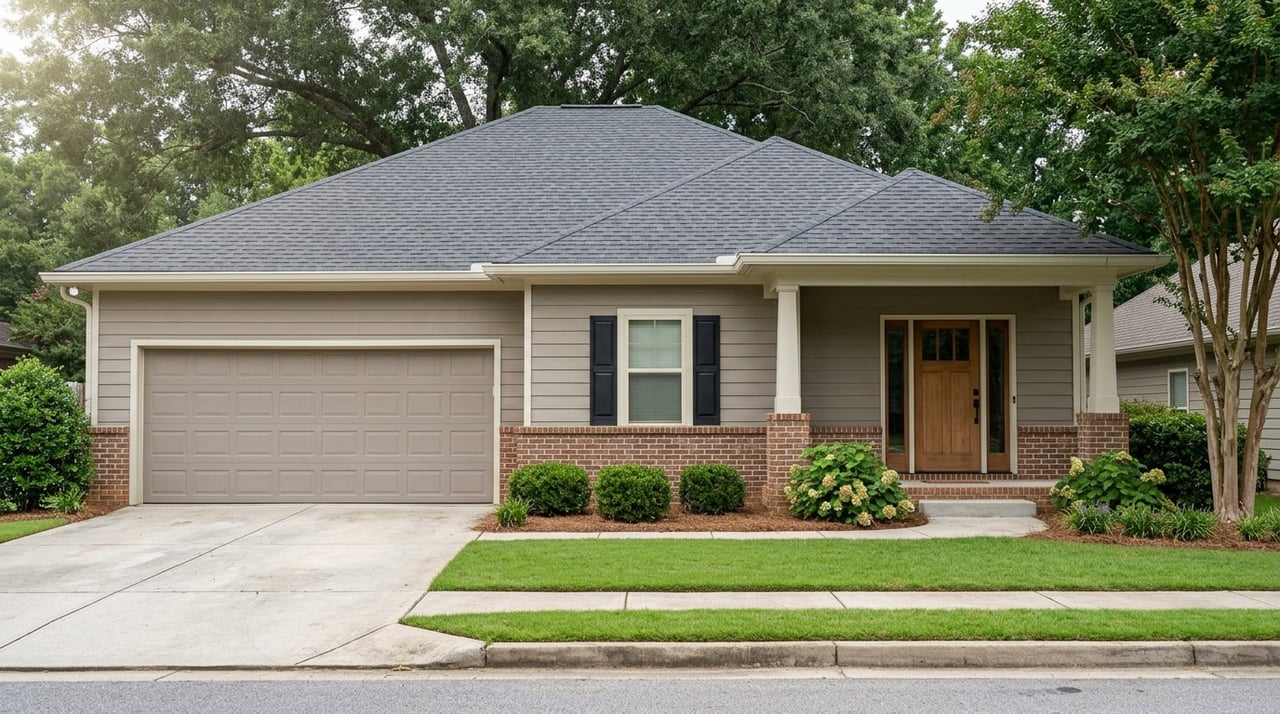
If you are looking for the most likely rental product in Douglasville, the data points you toward lower-density housing. In the ACS 2024 5-year profile, Douglasville has 15,356 housing units, and 63% are single-unit structures. That is an important clue for investors who want to match property type to the local market.
The renter share is also notable. About 52% of occupied housing units in Douglasville are renter occupied. That is a meaningful renter base for a suburban city and suggests renters are an important part of the local housing picture.
Douglas County as a whole looks even more single-unit heavy, with 80% single-unit structures. While countywide ownership levels are higher than in the city, the broader area still reinforces the idea that detached homes and similar property types play a major role in the market. For many small investors, that can make Douglasville especially relevant if your focus is single-family homes, townhomes, or other residential rentals rather than large multifamily buildings.
What Rent Levels Suggest
Rent data in Douglasville varies by source, so it helps to use each number as a market signal rather than a direct pricing answer. The city’s median gross rent is $1,582. Compared with the city’s median household income of $79,107, that works out to roughly 24% as a basic affordability yardstick.
HUD’s FY2025 metro benchmarks for the Atlanta-Sandy Springs-Roswell area provide another useful reference point. Those figures are $1,653 for a one-bedroom, $1,830 for a two-bedroom, $2,205 for a three-bedroom, and $2,653 for a four-bedroom. These are not Douglasville-specific asking rents, but they can help you frame expectations.
Public rent portals show a broad spread. RentCafe reports average apartment rent at $1,496, Zillow reports average rent across all bedrooms and property types at $1,959, and Trulia lists June 2026 averages of $1,200 for one-bedroom units, $1,418 for two-bedroom units, $1,879 for three-bedroom units, and $2,100 for four-bedroom units. Trulia also shows two-bedroom townhomes around $1,600 and three-bedroom townhomes around $2,199.
How To Read Rent Data Carefully
If those numbers feel inconsistent, that is normal. Different platforms track different property types, bedroom counts, and inventories. Some lean more toward apartments, while others may capture a wider mix of homes, townhomes, and rentals across price points.
For a small investor, the key takeaway is simple: do not underwrite from one headline rent number alone. Instead, compare the property type you want to buy with similar local inventory, then treat broader citywide averages as context. In Douglasville, that matters because the housing mix is not dominated by one uniform product.
Vacancy And Turnover Signals
Douglasville’s occupied share is 92%, which implies roughly 8% of housing units are vacant by broad ACS standards. Douglas County’s occupied share is 90%, implying about 10% vacant. That points to a market with ongoing leasing activity, but not one where you should assume every property fills instantly.
Turnover is another piece of the puzzle. In Douglasville, 16.6% of residents moved within the previous year. In Douglas County, the figure is 13.3%.
For you as an investor, that mix can be encouraging and cautionary at the same time. It suggests there is movement in the market and regular leasing opportunity, but also a realistic chance of tenant turnover, repair costs, and make-ready periods between leases. A deal can look strong on paper and still disappoint if you ignore normal vacancy and refresh costs.
Best Fit For Small Investors
Douglasville may make the most sense if you want a residential rental in a suburban setting with access to Metro Atlanta. The data suggests that single-family homes and townhome-style rentals are more aligned with the area than a strategy built around dense apartment inventory. That can be especially helpful if you prefer straightforward residential assets.
The city’s median age of 36.2 and commuter orientation may also support steady interest from working households looking for practical access, neighborhood amenities, and a more suburban housing style. While every property should be evaluated on its own merits, the broader market profile gives small investors a useful starting point.
Risks To Watch Before You Buy
No rental market is one-size-fits-all, and Douglasville is no exception. One of the biggest risks is assuming broad rent averages will apply to your exact property. A detached home, an older townhome, and a newer apartment can all sit in very different pricing lanes.
Another risk is overestimating occupancy. Even in a market with healthy demand signals, turnover and vacancy can still affect your cash flow. If you are building your numbers, it is wise to leave room for leasing time, maintenance, and periodic updates.
You should also pay attention to location-specific demand drivers within Douglasville. Access to I-20, proximity to downtown Douglasville, and the feel of the surrounding housing stock can all shape how a rental performs. Small differences on the map can influence rent, days on market, and tenant interest.
A Practical Investor Takeaway
If you are a small investor, Douglasville looks like a market worth serious consideration, especially if you prefer suburban residential rentals over large multifamily plays. The city combines a meaningful renter base, strong recent population growth, commuter access to Atlanta, and a housing stock that leans heavily toward single-unit structures. Those are useful ingredients for a buy-and-hold strategy, but only when paired with careful rent analysis and realistic expense planning.
The best opportunities are often the ones where the property type matches how the local market actually lives. In Douglasville, that likely means focusing on homes and low-density residential rentals that fit the city’s real housing pattern, not just chasing a headline number.
If you want help comparing Douglasville investment options, reviewing local housing patterns, or narrowing down a rental property strategy in Metro Atlanta, C Garrett Group, LLC offers thoughtful, hands-on guidance for buyers and investors.
FAQs
What kind of rental market is Douglasville for small investors?
- Douglasville appears to be a commuter-suburban rental market with a meaningful renter base, strong single-unit housing presence, and demand influenced by Atlanta access, local amenities, and redevelopment activity.
Are single-family rentals common in Douglasville?
- Yes. In Douglasville, 63% of housing units are single-unit structures, which suggests single-family homes and other low-density rentals are an important part of the market.
How much rent can investors expect in Douglasville?
- Rent levels vary by source and property type. Reported figures include a city median gross rent of $1,582, average apartment rent of $1,496 from RentCafe, average overall rent of $1,959 from Zillow, and Trulia ranges from $1,200 for one-bedroom units to $2,100 for four-bedroom units.
Is Douglasville a high-vacancy rental market?
- Broad ACS data suggests vacancy is modest rather than extreme. Douglasville’s occupied share is 92%, which implies about 8% vacancy across housing units.
What should Douglasville investors watch out for?
- You should watch for overreliance on broad rent averages, normal tenant turnover, make-ready costs, and the need to match your property type and location to actual local demand patterns.